What Problem Does RAG Solve?
Large Language Models (LLMs) work by learning patterns from massive amounts of preprocessed data. During inference, they generate text by predicting the next most likely token based on everything they have learned.
But what happens when you want an AI to answer questions about private company documents, internal knowledge, or sensitive business data?
You can't simply retrain the model every time because:
- Training is expensive and time-consuming.
- Sensitive data should not become part of the model's general knowledge.
- Private information must remain private.
To solve this problem, RAG (Retrieval-Augmented Generation) was introduced.
What is RAG?
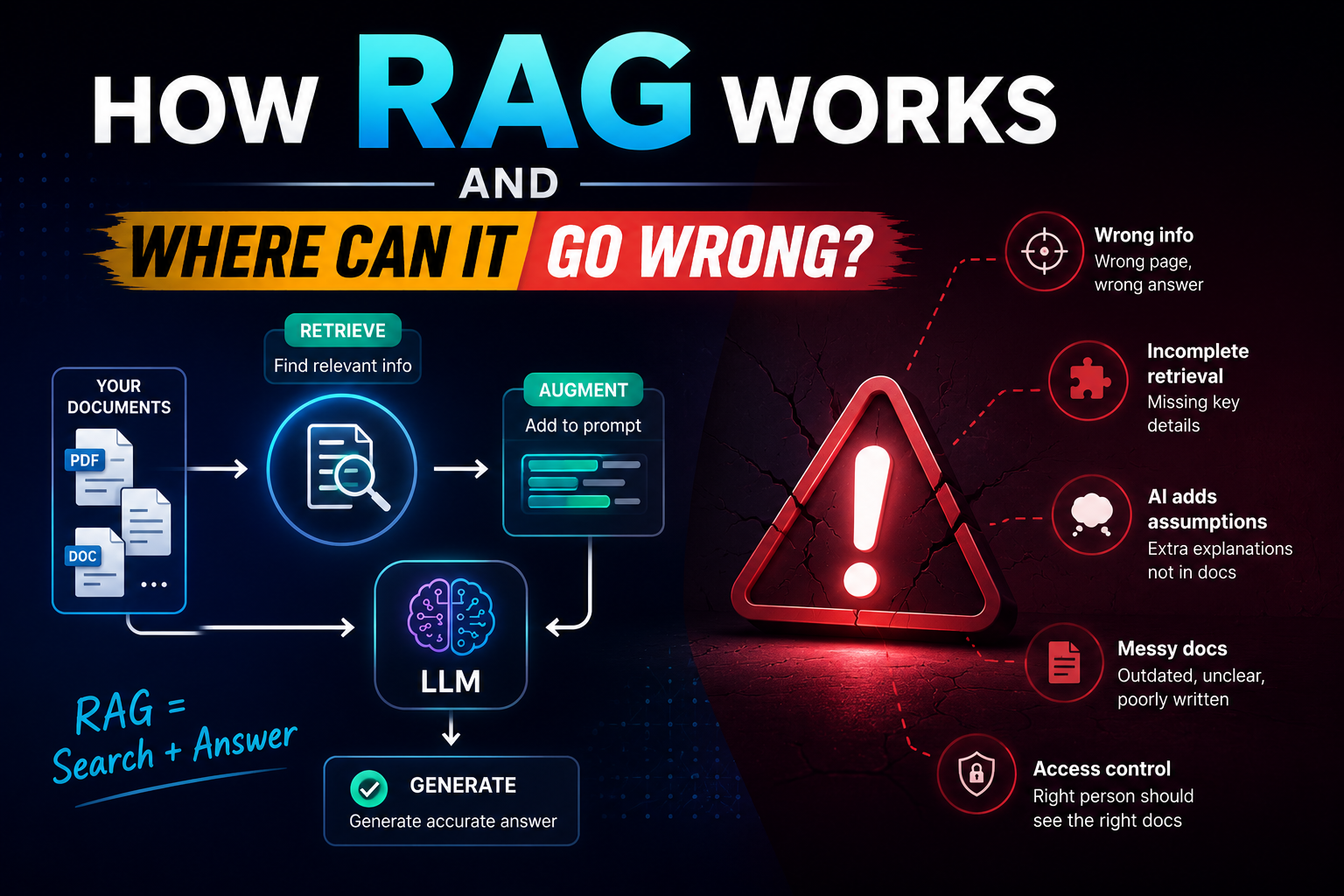
RAG (Retrieval-Augmented Generation) is a technique where an LLM retrieves relevant information from an external knowledge base before generating a response.
Instead of relying only on what it learned during training, the model first searches your documents and then answers using the retrieved context.
In simple words:
RAG = Search + Answer
How Does RAG Work?
RAG mainly consists of two stages.
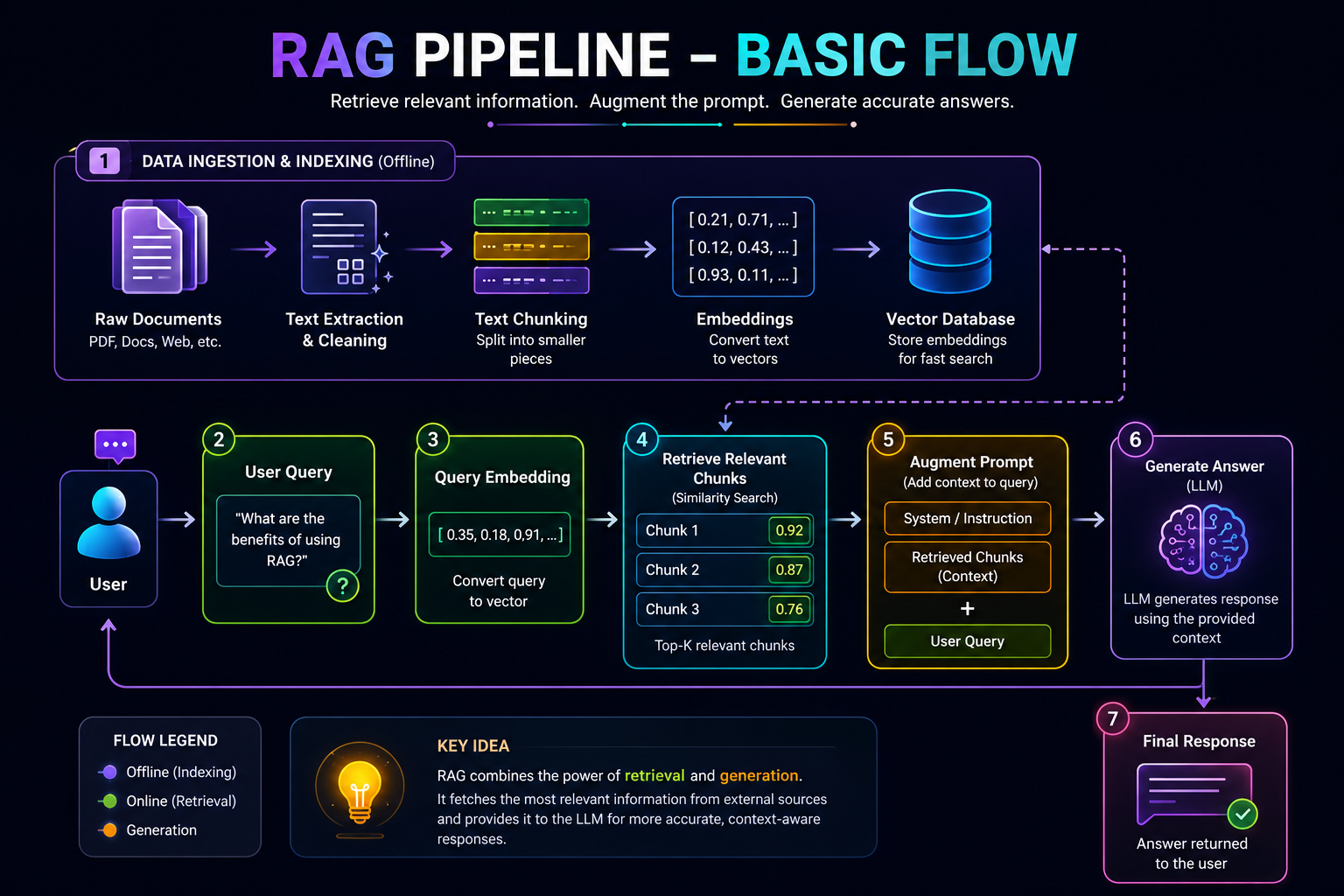
1. Indexing
During indexing, your documents are prepared so they can be searched efficiently later.
In simple terms:
- Collect your documents (PDFs, Docs, webpages, etc.)
- Split them into smaller chunks
- Convert each chunk into vector embeddings
- Store those embeddings inside a Vector Database
This creates a smart, searchable knowledge base.
2. Querying
When a user asks a question:
- Convert the user's query into an embedding.
- Search the vector database for the most relevant chunks.
- Retrieve the best matching information.
- Send the retrieved context along with the user's question to the LLM.
- The LLM generates the final answer using that context.
Limitations of RAG
Although RAG significantly improves the quality of responses, it is not perfect.
1. Wrong Retrieval = Wrong Answer
RAG is only as good as the information it retrieves.
If it fetches the wrong paragraph or document, the LLM will confidently generate an incorrect answer.
2. Incomplete Retrieval Leads to Incomplete Answers
Sometimes the required information is spread across multiple documents.
If RAG retrieves only one relevant chunk, the generated answer may miss important details.
3. The LLM Can Still Hallucinate
Even when the correct context is provided, the model may:
- Add unnecessary explanations
- Make assumptions
- Connect facts that aren't actually present in the documents
So while RAG reduces hallucinations, it doesn't eliminate them completely.
4. Poor Documents Produce Poor Answers
RAG cannot fix bad documentation.
If your documents are:
- Outdated
- Incorrect
- Poorly written
- Missing important information
then the generated answers will also suffer.
5. Access Control Is Critical
Using RAG with private company data requires proper security.
You must ensure:
- The right users can access the right documents.
- Private documents are never exposed to unauthorized users.
- Permissions are enforced before retrieval.
RAG is safer than retraining on sensitive data, but security must still be implemented correctly.
Final Summary
Traditional LLMs generate answers based only on what they learned during training through next-token prediction.
However, training an LLM on private company data is usually impractical and unsafe.
RAG solves this problem by allowing the model to retrieve relevant information first and then generate responses using that retrieved context.
While RAG greatly improves accuracy, it still has limitations:
- Wrong retrieval leads to wrong answers.
- Missing context results in incomplete responses.
- The LLM may still hallucinate.
- Poor documentation reduces answer quality.
- Access control and security remain essential.
One-Line Takeaway
RAG = Search + Answer